Hello World
After 16 years as a software engineer I have to relearn my craft, and this blog is where I work out what AI changes about the job.
What a great time to finally start a tech blog!
What appealed to me in the idea of writing is that it works as a checkpoint. When you start learning something big, putting your own distilled understanding out there shows how much of it you really have. The brilliance of a tech idea in my head faded quite fast once it landed on paper, or once I tried to say it out loud to a friend or a colleague. So as I progressed in my career, I had to improve my tech writing skills.
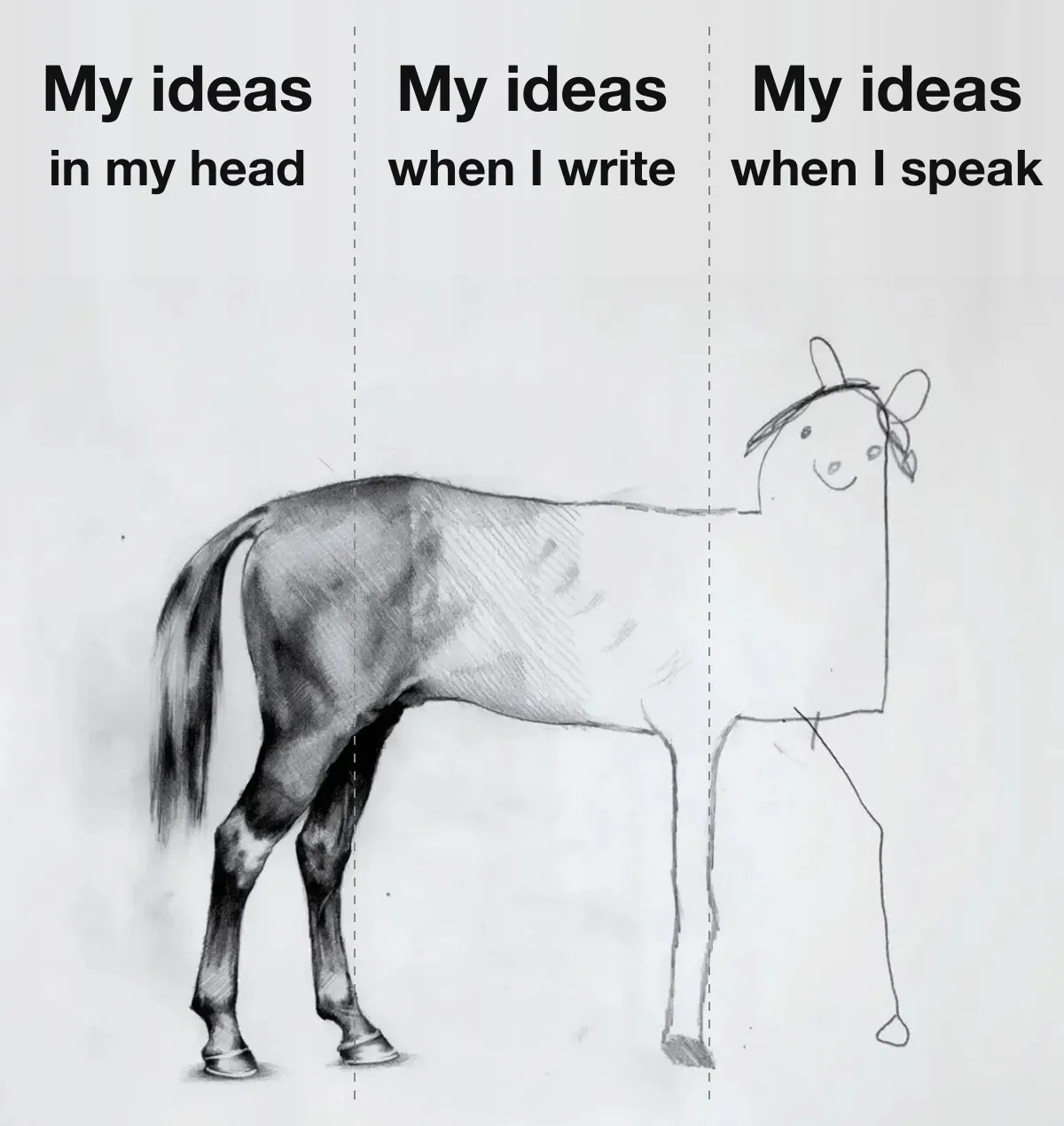
Drawing: Ali Bati
Why not earlier
In my 16 years as a software engineer I thought about starting a blog on and off, but I never got to setting up a website. I wasn’t sure I would have enough topics, or that I could commit the time to write regularly. Life happened in between, and at some point I stopped actively learning and trying to keep up with an already fast-paced industry.
So why now?
Well, I feel like I have to learn again… rediscover my craft from the very beginning… again. Like all of us, I’ve developed my workflows for solving software problems and nailed them down over 16 years in the industry. However, in these turbulent AI times it is not clear what software engineering as a job will look like. What mattered yesterday might not be relevant at all tomorrow. And honestly, keeping up with the changes is a separate full-time job.
For almost two years now I have been exploring the AI world and trying things out, mostly around developer productivity, because everything else builds on it. I quickly realised that adding AI to separate steps of the software development lifecycle (SDLC), each on its own, does not work. The developer workflow has to be sorted out first. For me that meant taking it apart, analysing it, and putting it back together for the new reality.
Nobody has a clear picture yet
I’m neither an AI skeptic nor a believer that it will replace the software engineering job. But I strongly believe it will reshape software engineering in ways no one has a clear picture of yet. There are a lot of experiments with agent-first IDEs, new tools and various flavors of agentic harnesses, and they are all taking us out of the comfort zone we built over years of working the same way.
But these tools haven’t yet proved that the workflows they offer are here to stay: we still try to fit them into the existing SDLC. Our development and delivery systems were built on assumptions about how fast humans can write code. Now even the biggest tech companies acknowledge that producing ten times more code snowballs through every other part of the SDLC. Adam Bender of Google argues this in his Google I/O 2026 talk, Software engineering at the tipping point. That suggests the SDLC itself might be reshaped to keep up.
And even though no one knows the target picture, people and companies have to start experimenting with AI somewhere, and they are most likely starting in an existing product that was designed at a time when AI was not even on the horizon. Those experiments will go on until a critical mass of failures and learnings emerges to rethink the SDLC and the role (and likely the scope) of the software engineer.
What is left for the engineer
What will a software engineer’s day look like? What tools will they use? Do we still need bloated IDEs? Will engineers read code at all? How will they evaluate the software? Will we still be building web pages, or will everything become native apps? What will an engineer do when something breaks?
And if the answer to that is “just tell Claude to fix it”, then I, unfortunately, believe the software engineer disappears as a job. If all engineering comes down to a human triggering agents, the human becomes human middleware. Richard Foster-Fletcher, who named the term, suggests this is likely the new permanent state of work, and not a phase we pass through. I see it differently: the value of an engineer’s knowledge and expertise changes radically in that role, and is likely to be replaced completely as model capabilities grow. And an important part of why people became engineers was that they had fun writing code, and that seems to be gone from the job.
But I guess the industry will shape a new job profile, one that might have neither “software” nor “engineer” in its name, which today’s developers will transition into.
What to expect here
With this blog I aim, first of all, to figure out for myself what the industry now expects of human expertise in software engineering and which new job profiles emerge. Then, which of them appeals to me most, and what my skill gap is.
I hope it also helps someone out there understand what the new software engineer profile will be, and work towards it.